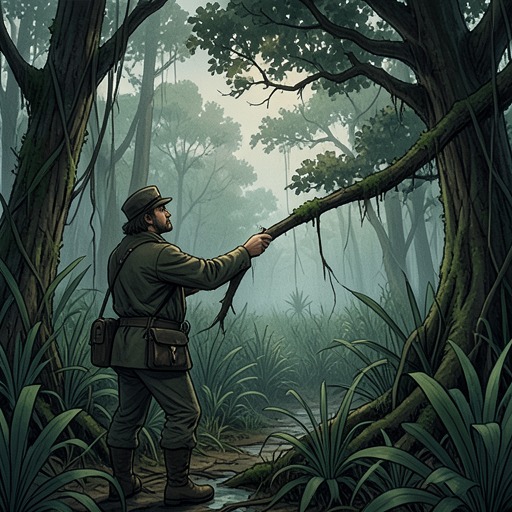
Nature’s Laws of Survival and Morality
Where the Crawdads SingNature’s Laws of Survival and Morality is the idea that biological behavior can be understood in terms of survival and reproduction even when it appears cruel by human standards. Through Kya’s close observation of animals and her study of biology, the book offers nature as a source of explanatory patterns, but not as a final moral verdict: understanding why abandonment or deception might persist does not make either harmless or right.
Nature as a Field of Knowledge
Kya’s understanding grows from joining what she has seen firsthand to what she reads. Alone by lantern light, she studies how plants and animals change as the earth shifts, how cells specialize into organs or remain available as stem cells, and how the cool, moist morning air carries birdsong farther. These explanations feel accessible because she has long watched the marsh’s living processes at close range. Nature is not merely an illustration in a book for her; it is a field of evidence she has already learned to observe.
That confidence also makes biology a way to approach a question that has haunted her: why a mother would leave her offspring. Kya searches the biological world for an explanation, bringing the abstract study of adaptation into intimate contact with her own childhood. The search offers a framework for thinking, not a personal answer that can erase what happened.
Fireflies and Deceptive Signals
One night, while waiting for Tate’s boat and then watching the lagoon, Kya turns her attention to fireflies. She remembers Jodie teaching her that females signal readiness to mate with flashes beneath their tails, and that each species has its own pattern. The visible differences matter: males respond to the signals belonging to their own species, so the flashes operate as a language with practical consequences.
Kya then notices a female alter her signal. After attracting and mating with a male of her own species, the female gives a different pattern that draws a male of another species. He mistakes the signal for an invitation to mate; instead, she catches and eats him, consuming his legs and wings. Kya watches other females repeat the strategy. The scene joins precise observation to a sharp reversal: a signal that appears to promise reproduction becomes a means of securing food.
The encounter leads Kya to resist treating the animal’s behavior as a human moral drama. In this account, the deception is part of life’s workings, and survival continues at another creature’s expense. That perspective does not deny the violence of the act; it changes the terms in which Kya interprets it. The lagoon’s life and decay coexist, while the fireflies make predation visible within the same natural order as courtship.
Mating Strategies and Their Limits
Kya encounters a related problem in a scientific digest’s article on reproductive strategies. Its account contrasts imposing males, who secure territories and attract mates, with weaker males that use concealment or false signals to gain opportunities. Bullfrogs provide the concrete example: a smaller male hides near a loudly calling dominant male, then takes advantage of the moment when the dominant male is occupied mating. The explanation makes deception one strategy within competition, rather than an isolated violation of an otherwise peaceful natural world.
The article also offers a counterpoint: males that send dishonest signals or move from one female to the next almost always end up alone. That observation gives Kya a consolation, but it is a qualified one, not proof that every deception is punished or that natural outcomes are fair. A memory of Ma warning her older sisters about noisy, unworthy young men links the scientific account to human courtship, while keeping the distinction between animal behavior and human responsibility in view.
Parenthood, Abandonment, and Forgiveness
When Jodie reunites with Kya, she describes how a vixen may leave her kits if starvation or extreme stress threatens her survival. The kits may die, but the mother may live to breed again when conditions improve. Kya has read further about such behavior: if abandoning offspring in crisis increases a mother’s number of young over her lifetime, the tendency can persist through generations. She applies this possibility to Ma, proposing that the stress and danger of living with her father may have driven her departure through an ancient survival impulse.
Kya’s reasoning is not an acquittal. She says Ma should have stayed, and she cannot understand why Ma never returned or wrote. Biology may help Kya imagine a cause for leaving, but it cannot supply the missing explanation for the years of silence. Her distinction is central to the concept: an account of inherited behavior can make forgiveness imaginable without converting abandonment into a right action or resolving the injured person’s questions.
A painting of gulls brings the same uncertainty into view on a smaller scale. Kya recalls that Ma fed gulls when she could and gave them names, including Big Red; the bird she identifies in the painting belongs to a later generation. Kya knows that a red spot on a herring gull’s bill prompts its chicks to peck, and that the parent releases captured food only when they do. If the spot is obscured and the chicks fail to tap it, the parent does not feed them and they die. The detail makes care depend on a narrow, consequential signal. Parenthood in nature may be more precarious than it appears, but that observation does not make Kya’s own experience of being left less real.
Taken together, these examples make nature an interpretive resource rather than a court of moral judgment. Fireflies deceive, animals compete, and parental care can turn on conditions or signals; such patterns help Kya think about survival and inherited behavior. Yet her questions about Ma remain partly unanswered. The book holds explanation and accountability beside each other, refusing to let a biological analogy stand in for the full complexity of a human relationship.